
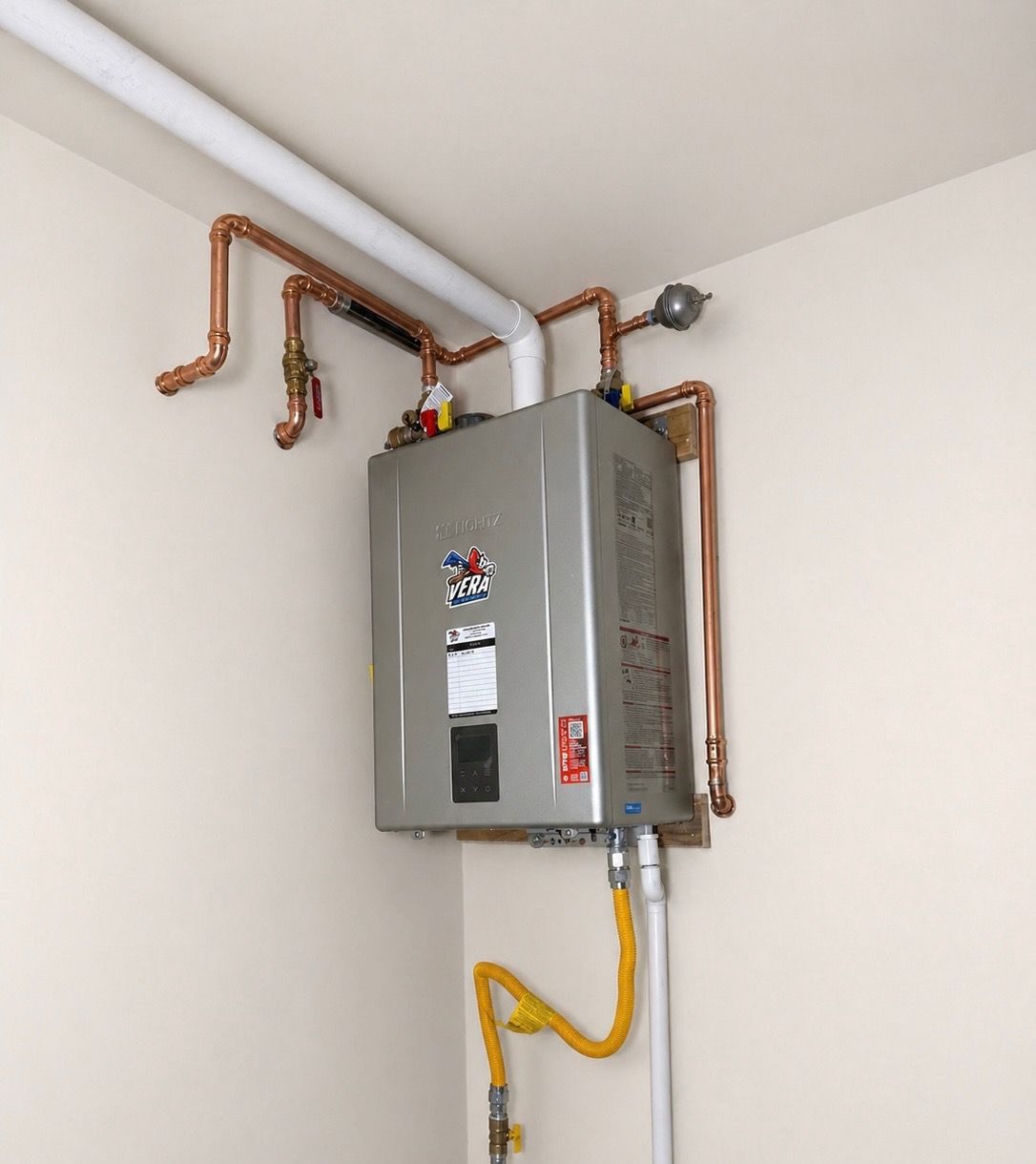
Running out of hot water halfway through a shower, or watching an aging tank rust in the garage and wondering when it will let go — those are the two moments most people start looking at tankless. Vera Plumbing & Drain installs tankless water heaters throughout Jurupa Valley, handling the parts that actually decide whether the unit performs: gas line sizing, venting, water and gas pressure, and protection against the hard water this area is known for. We size the system to your home’s real demand, not a generic square-footage chart.
What tankless water heater installation involves
A tankless unit heats water on demand through a heat exchanger instead of storing it, so the install is more than a swap. It starts with load math: how many fixtures might run at once, the incoming groundwater temperature, and the temperature rise you need to hit. That determines the gallons-per-minute rating and the BTU input.
From there the work is mechanical. Most gas tankless heaters need 150,000–199,000 BTU, which frequently means the existing half-inch gas branch is undersized. We verify the meter capacity and run new black iron or CSST where the calculation calls for it. Venting changes too — tankless units use sealed stainless or polypropylene concentric venting through a sidewall or roof, not the old B-vent the tank used.
Then the water side: mounting brackets on a structurally sound wall, new copper or PEX supply and return, isolation service valves so the unit can be flushed, a pressure relief line routed to an approved point, and condensate handling on condensing models. Electrical gets a dedicated circuit for the controls and fan. If you’re replacing a 50-gallon tank, the recovered floor space is a real bonus in a tight Jurupa Valley garage or utility closet. We finish by commissioning the unit — checking manifold pressure, combustion, flow rate, and setpoint temperature — and confirming the whole house delivers steady hot water.
Why Vera Plumbing & Drain for tankless water heater installation
- Load-based sizing, not guesswork. We count simultaneous fixtures and calculate temperature rise before recommending a GPM rating, so you don’t end up with a unit that cold-water-sandwiches every morning.
- Gas and venting done properly. We size the gas line to the appliance’s BTU demand and install manufacturer-approved concentric venting rather than reusing an old tank flue.
- Hard-water planning built in. Inland Empire water scales heat exchangers fast. Every install gets isolation service valves for descaling, and we’ll talk through scale-reduction options and a flush interval that fits your water.
- Retrofit specialists. Tank-to-tankless conversions in Jurupa Valley homes usually involve tight garages, stucco sidewall penetrations, and rerouted supply lines. That’s the majority of what we do.
- Commissioning and a walkthrough. We verify performance at the fixtures, set your temperature, and show you the remote controller, error codes, and flush ports before we leave.
Our tankless water heater installation process
- Phone consultation. We ask about your home’s fixture count, current heater, fuel type, and what’s frustrating you about hot water now.
- On-site assessment. We inspect the existing heater location, gas meter and line size, venting path, electrical availability, and water pressure, then discuss indoor versus outdoor mounting.
- Written proposal. You get a clear scope: unit model and GPM rating, gas work, venting, valves, condensate, electrical, and permit handling — line by line, with no surprise add-ons.
- Removal and prep. We drain and haul away the old tank, cap or reroute abandoned lines, and prepare the mounting wall.
- Installation. Unit mounted and secured, gas line sized and pressure-tested, vent terminated at approved clearances, water lines and service valves tied in, condensate routed, dedicated circuit connected.
- Commissioning and testing. We purge air, verify gas pressure under load, check combustion and flow, set the output temperature, and test hot water at every fixture.
- Walkthrough and cleanup. We explain operation, maintenance intervals, and descaling, then clear the work area and remove all debris.
What tankless water heater installation typically costs
Tankless installation costs vary more than tank replacement because so much depends on your home’s existing infrastructure. Estimates range based on the unit’s GPM and BTU rating, whether it’s a condensing or non-condensing model, how much gas line has to be upsized and how far it runs from the meter, the venting path and number of penetrations, whether the location moves from indoors to an exterior wall, condensate drainage availability, and electrical work for a dedicated circuit.
A straight swap where the gas line is already adequate and the vent path is short sits at the lower end. Costs climb when we’re running new gas from a distant meter, relocating the unit, adding a recirculation pump, or coring through block or stucco. Our quotes include the unit, all labor, gas and vent materials, isolation service valves, permit handling, and removal of the old heater. Not included: whole-home water treatment, repiping beyond the immediate connections, or drywall finishing where access was required. Call for a free on-site quote and you’ll get real numbers for your specific home, not a range.
Service areas we cover
- Jurupa Valley
- Rubidoux
- Mira Loma
- Glen Avon
- Pedley
- Sunnyslope
- Belltown
- Indian Hills
- Crestmore Heights
FAQ
How long does a tankless water heater installation take?
A straightforward conversion typically runs most of a day. If the gas line needs upsizing from the meter, the unit is relocating to an exterior wall, or a new vent path has to be cut, plan on a day and a half to two days.
Will one tankless unit supply hot water to my whole house?
Usually yes, if it’s sized right. A properly rated unit handles two or three simultaneous fixtures in most Jurupa Valley homes. Larger houses with several baths running at once may need a higher-GPM model or two units manifolded together — that’s what the sizing calculation determines.
Do I need to upgrade my gas line?
Often. A tank heater might draw 40,000 BTU while a tankless draws 150,000 or more. We measure the existing pipe size, length of run, and meter capacity to determine whether the current line can carry the load or needs upsizing.
How does hard water affect a tankless heater?
Scale builds up on the heat exchanger, reducing efficiency and eventually triggering error codes. That’s why we install isolation service valves on every unit so it can be descaled with a flush kit. We’ll recommend an interval based on your water.
Can a tankless unit be installed outdoors?
Yes — outdoor-rated models are common in Southern California and they eliminate indoor venting entirely, which often simplifies the job. Freeze protection matters less here than in colder climates, though we still confirm the location is suitable.
Is a permit required?
Water heater replacements involving gas and venting changes are permitted work. We handle the permit process as part of the job.
Ready to stop rationing hot water? Vera Plumbing & Drain will come out to your Jurupa Valley home, measure your gas line and venting options, size the right unit for your actual demand, and give you a free written quote with no pressure attached. Call (951) 741-8270 to schedule your tankless water heater installation estimate.